Breast Ptosis
Sagging Breasts

You will always be beautiful.
You will be beautiful, always.
Sagging breast surgery (breast lift) raises breasts that have drooped due to aging, pregnancy, breastfeeding, and other causes, repositioning and securing them — together with the nipple and areola — in their normal position.
Sagging breast surgery (breast lift) raises breasts that have drooped due to aging, pregnancy, breastfeeding, and other causes, repositioning and securing them — together with the nipple and areola — in their normal position.
Regardless of breast size, significant sagging makes you a candidate for surgery.
Who needs surgery
- When breasts sag due to aging or childbirth
- If your breasts sag because they are excessively large
- When breasts have deflated or shrunk after breastfeeding
- If you want to lift sagging breasts with minimal scarring
- When you are dissatisfied after a previous periareolar or vertical incision
Self-Diagnosis
Assess for yourself how much your breasts sag.

Normal nipple
the nipple, relative to the inframammary fold,
Positioned 4–5 cm above
Positioned 4–5 cm above

Grade 1
the nipple, relative to the inframammary fold,
Within 1 cm
Within 1 cm

Grade 2
the nipple, relative to the inframammary fold,
Within 1–3 cm
Within 1–3 cm

Grade 3
the nipple, relative to the inframammary fold,
Descended 3 cm or more
Descended 3 cm or more

Pseudoptosis
The nipple is normal, but
When the glandular tissue has descended below
When the glandular tissue has descended below

Other atypical breast shapes
Normal nipple
The nipple sits 4–5 cm above the inframammary fold
Grade 1
When the nipple sits within 1 cm below the inframammary fold
Grade 2
When the nipple sits 1–3 cm below the inframammary fold
Grade 3
When the nipple has descended 3 cm or more below the inframammary fold
Pseudoptosis
When the nipple is normal but the glandular tissue has dropped below
Other atypical breast shapes
Small-i Lifting
About Small-i Lifting Surgery for Breast Ptosis
Small-i Lifting
About Small-i Lifting Surgery
for Breast Ptosis
The key to sagging breast surgery is leaving the smallest scar possible. That is how Small-i Lifting was born.
Do you want to lift your sagging breasts and your self-esteem, but worry about scars?
Small-i Lifting distills 19 years of know-how in lifting sagging breasts. It is a surgical technique I perfected by improving on the drawbacks of conventional incision methods and bringing together only their strengths, drawing on the countless consultations and lifting experience gained while hosting Q&A sessions in online moms' communities.

Surgery duration
Within 2 hours

Drain
None

Inpatient care
Same-day discharge

Massage
Not needed

Anesthesia method
General anesthesia

Stitch removal
When needed

In-clinic treatment
Week 1

Aftercare
Weeks 1, 2, 3, 4, and 12
Principle of Small-i Lifting
The principle of Small-i Lifting
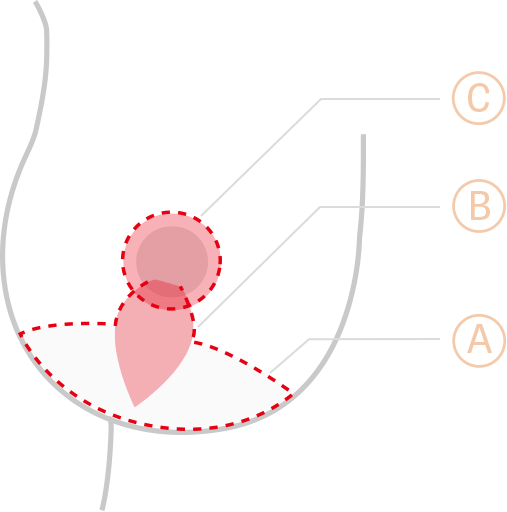
C. A circular incision performed alongside areola reduction (mild)
B. A vertical incision to remove excess skin in the horizontal direction (moderate)
A. A horizontal incision to remove excess skin in the vertical direction (severe)
B. A vertical incision to remove excess skin in the horizontal direction (moderate)
A. A horizontal incision to remove excess skin in the vertical direction (severe)
The circular incision required for areola reduction (mild)
A vertical incision to remove excess skin in the horizontal direction (moderate)
A horizontal incision to remove remaining vertical excess skin (severe)
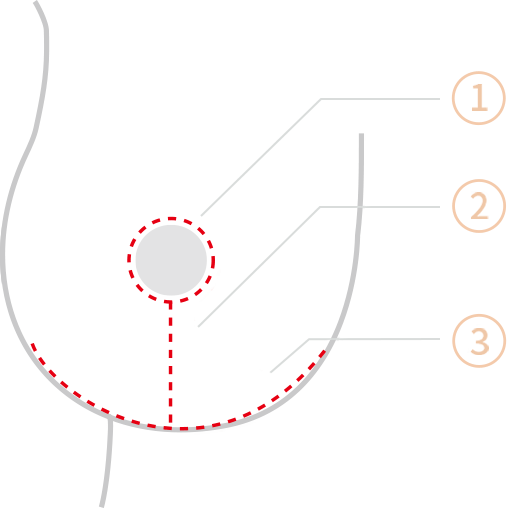
1. A clean, round areola shape with minimal distortion
A clean areolar scar with minimal puckering and unevenness
Areola reduction possible to a small, neat 35~38mm size
A clean areolar scar with minimal puckering and unevenness
Areola reduction possible to a small, neat 35~38mm size
2. Short-scar technique keeps the scar short
Low-tension technique for scars with minimal widening
A perky, teardrop-shaped side profile rather than a flat, wide one
Low-tension technique for scars with minimal widening
A perky, teardrop-shaped side profile rather than a flat, wide one
3. A short inframammary incision allows faster recovery
Medical-grade adhesive means no stitches and same-day showering
Size and nipple height can be selected to suit your body type
Medical-grade adhesive means no stitches and same-day showering
Size and nipple height can be selected to suit your body type
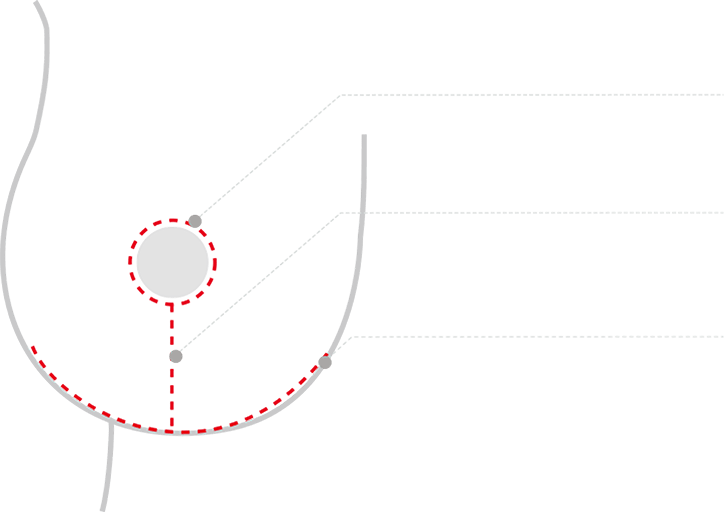
· A clean, round areola shape with minimal distortion
· A clean areolar scar with minimal bumps and puckering
· Areola reduction to a petite 35–38 mm
· A clean areolar scar with minimal bumps and puckering
· Areola reduction to a petite 35–38 mm
· Short-scar technique keeps the scar short
· Low-tension technique for scars with minimal widening
· A gently domed, teardrop-shaped side profile — never flat and wide
· Low-tension technique for scars with minimal widening
· A gently domed, teardrop-shaped side profile — never flat and wide
· A short inframammary incision allows faster recovery
· Medical-grade skin adhesive — no stitches to remove, shower the same day
· Size and nipple height can be chosen to suit your body type
· Medical-grade skin adhesive — no stitches to remove, shower the same day
· Size and nipple height can be chosen to suit your body type
Surgery Method
Surgical methods for sagging breasts
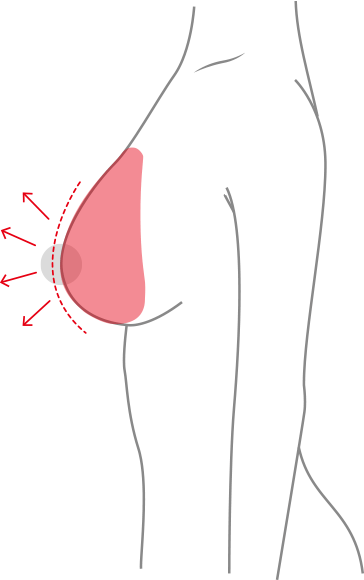
Implant-only breast augmentation
This method is mainly used for small breasts with little elasticity (grade 1~2 ptosis). Since most patients are reluctant about the scars of ptosis correction, I resolve sagging breasts with augmentation alone.
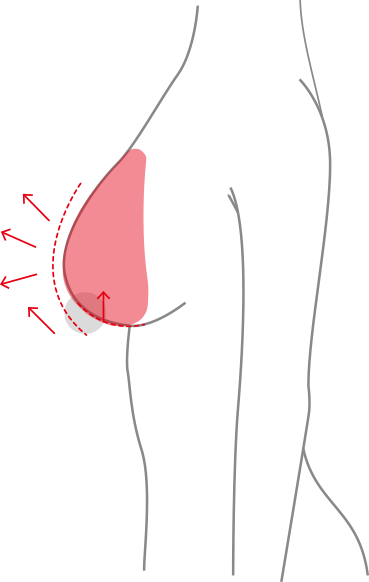
Implant + Small-i Lifting
This method is used mainly for severely sagging breasts (grade 3 ptosis or higher), where implant augmentation alone cannot fully lift the drooping skin.
In this case, Small-i Lifting is performed, finishing with a small, clean scar.
In this case, Small-i Lifting is performed, finishing with a small, clean scar.
Implant-only breast augmentation
This method is mainly used for small breasts with little elasticity (grade 1~2 ptosis). Since most patients are reluctant about the scars of ptosis correction, I resolve sagging breasts with augmentation alone.
Implant + Small-i Lifting
This method is used mainly for severely sagging breasts (grade 3 ptosis or higher), where implant augmentation alone cannot fully lift the drooping skin. In these cases, Small-i Lifting is performed, finishing with a small, clean scar.
Types of Incisions
Types of incisions
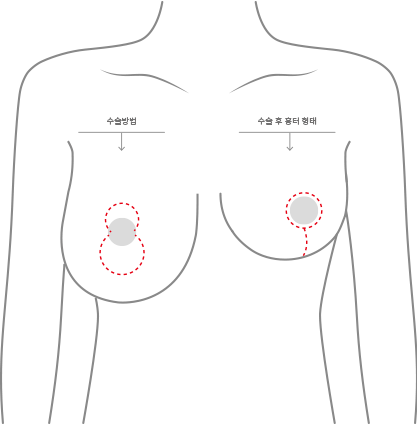
Vertical incision technique
This is the method used for most ptosis corrections; it can raise the nipple to the desired position and allows simultaneous areola reduction.
The areola shape can sometimes turn out uneven. It is difficult to fill deflated upper-pole volume. The vertical scar can be long and may extend below the inframammary fold.
The areola shape can sometimes turn out uneven. It is difficult to fill deflated upper-pole volume. The vertical scar can be long and may extend below the inframammary fold.
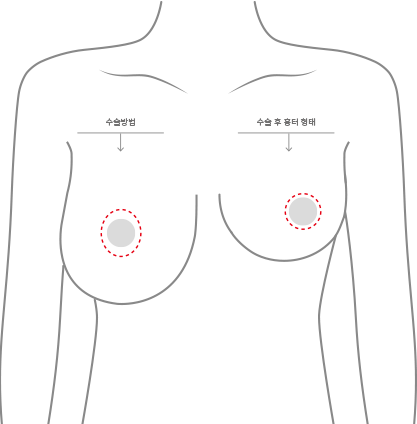
Periareolar incision technique
This method lifts the nipple slightly with a short scar. However, it cannot raise the nipple position very much.
The areola-reduction effect is limited and the areola widens again. The scar puckers into an uneven shape. The breast looks flat and wide rather than perky.
The areola-reduction effect is limited and the areola widens again. The scar puckers into an uneven shape. The breast looks flat and wide rather than perky.
Vertical incision
This is the method used for most ptosis corrections; it can raise the nipple to the desired position and allows simultaneous areola reduction. The areola shape can sometimes turn out uneven. It is difficult to fill deflated upper-pole volume. The vertical scar can be long and may extend below the inframammary fold.
Periareolar incision
This method lifts the nipple slightly with a short scar, but it cannot raise the nipple position very much. The areola reduction effect is limited and the areola widens again. The scar puckers and becomes uneven, and the breast ends up wide and flat rather than rounded.
Even more cherished after surgery!
Aftercare by U&U
We do not just check your progress and hand aftercare off to staff. The surgeon who operated on you personally provides your aftercare, so you can ask about any post-operative discomfort in detail and without feeling rushed.
We do not just check your progress and hand aftercare off to staff. The surgeon who operated on you personally provides your aftercare, so you can ask about any post-operative discomfort in detail and without feeling rushed.


Side effects such as bleeding, infection, and inflammation can occur after surgery and vary in severity by individual, so caution is required.
Before & After
Sagging Breasts / Before & After Photos
Individual results may vary.